|
| Carlos Eduardo Thomaz |
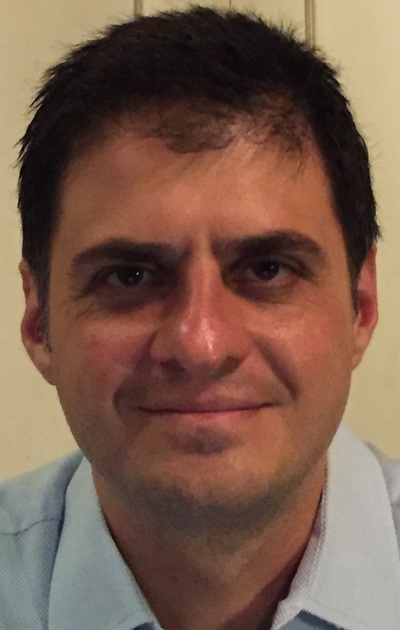 |
| Departamento de Engenharia Eletrica FEI
Av. Humberto de Alencar Castelo
Branco, 3972 - Assuncao
Sao Bernardo do Campo - Sao
Paulo - Brazil - CEP 09850-901
Office: K5-01
Tel: +55 (0)11 4353 2910
(ext. 2183)
Fax: +55 (0)11 4109 5994
Email: my initials
@fei.edu.br
[How
to reach FEI in Sao Bernardo do Campo, Map of the campus]
|
Short Biography: Carlos Eduardo Thomaz is
Professor of Statistical Pattern Recognition at the Department of
Electrical Engineering, University College (Centro Universitario)
FEI, Sao Paulo, Brazil. He is head of the Image Processing Lab at FEI. Carlos Thomaz received, in 1993, his B.Sc.
degree in Electronic Engineering from Pontifical Catholic
University of Rio de Janeiro (PUC-Rio),
Rio de Janeiro, Brazil. After working for six years in industry,
he obtained the M.Sc. degree in Electrical Engineering from
PUC-Rio in 1999. In October 2000, he joined the Department of
Computing at Imperial
College London, UK, where he obtained
the Ph.D. degree in Statistical Pattern Recognition in 2004. His
main research interests are in Pattern Recognition, Cognitive
Perception and Machine Learning and over these years he has
published more than 150 journal and conference articles on these
topics. Professor Thomaz was awarded, in 2012, a University of
Nottingham Brazil Visiting
Fellowship to work during three months
in the Sir Peter Mansfield Magnetic Resonance Centre, UK. He is an associate editor of IEEE Latin America Transactions,
member of the editorial board of PLOS ONE and has served as a member of organising and program
committees at a number of national and international conferences.
From 2015 to 2018, he was awarded a Newton Advanced Fellowship
from the
Royal Society, UK. In 2020, he received
the Fernandes Figueira Award from
the National
Academy of Medicine (Brazil) for his
work on human visual perception of neonatal pain developed in
collaboration with researchers of the Federal University of Sao
Paulo (UNIFESP). Some recent mentoring results of his research
activities have become a finalist project in the 2nd edition of H-INNOVA Health Innovation Award (2020/2021) and in the 8th edition of Semana Municipal de Ciencia, Tecnologia e Inovacao de
Santo Andre (2022), as well as the 3rd
place project (PhD/Researchers Category ) in the 5th edition of H-INNOVA Health Innovation Award (2024).
Research
Opportunities
Our research
activities are mainly related to high-dimensional data analysis.
We essentially investigate, propose and implement statistical and
machine learning methods to extract, visualize, understand and
classify patterns on signal and information (visual and
cognitive) processing. Such multivariate data signal and
information might be an image, like a human face, a non-invasive
measurement of activity in the human brain, like
electroencephalography, a human visual perception of an object of
interest, like eye-tracking, or even an automotive judder like
the vehicle longitudinal oscillation during its clutch system
engagement. For further details, please see our Research, Publications, or Image
Processing Lab homepages, or contact me
directly.
[Teaching, Research,
Publications, FEI Face Database]
Recent works
L. A. Ferreira, C. Pirie, G. A. S. Coutrin, L. P. Carlini, C.
F. Moreno-Garcia, M. C. M. Barros, R. Guinsburg, and C. E.
Thomaz. From pixels to pain scales: Robust evaluation of
explainable AI in neonatal pain detection. In proceedings of the
4th World Conference on eXplainable Artificial Intelligence, XAI 2026, 22pp.,
Fortaleza, Brazil, 01-03 July 2026 (to appear).
L. A. Ferreira, L. P. Carlini, G. A. S. Coutrin, L. F. Buzuti,
R. G. Magalhaes Jr, R. N. Orsi, T. M. Heiderich, G. Cianciarullo,
S. P. Gimenez, C. Pirie, C. F. Moreno-Garcia, M. C. M. Barros, R.
Guinsburg, and C. E. Thomaz. Barriers and pathways to clinical
translation of AI in automated neonatal pain assessment. In the
26th Simposio Brasileiro de Computacao Aplicada a Saude, SBCAS
2026, I Workshop de Grandes
Desafios da Computacao Aplicada a Saude, pp. 86-97, Ouro
Preto, Minas Gerais, Brazil, 1-4 June 2026.
R. G. Magalhaes Jr, R. N. Orsi, T. M. Heiderich, M. C. M.
Barros, R. Guinsburg, and C. E. Thomaz. Representacao
por grafos do comportamento visual humano na avaliacao da dor
neonatal. In proceedings of the 26th Simposio Brasileiro de
Computacao Aplicada a Saude, SBCAS
2026, pp. 133-144, Ouro Preto, Minas Gerais, Brazil, 1-4 June
2026.
L. F. Buzuti and C. E. Thomaz. Inteligencia Artificial
Generativa com Dados Limitados: Superando Desafios na Avaliacao
Automatica da Dor Neonatal. In proceedings of the 26th Simposio
Brasileiro de Computacao Aplicada a Saude, SBCAS
2026, Concurso de Teses e Dissertacoes (CTD), 6pp., Ouro
Preto, Minas Gerais, Brazil, 1-4 June 2026 (to appear).
P. C. P. Franco, M. C. M. Barros, R. G. Magalhaes Jr, S. Y. T.
Assuncao, B. M. Mello, A. S. S. Marinomio, M. D. Kawakami, M. H.
Miyoshi, M. F. Almeida, T. M. Heiderich, R. N. Orsi, C. E.
Thomaz, and R. Guinsburg. Physicians' eye-tracking in Neonatal
Intensive Care: Evaluating a mechanical ventilator panel, Revista Paulista de Pediatria,
2026 (accepted).
S. Y. T. Assuncao, M. C. M. Barros, R. G. Magalhaes Jr, P. C.
P. Franco, B. M. Mello, M. D. Kawakami, A. S. S. Marinomio, A.
Sanudo, M. H. Miyoshi, M. F. Almeida, T. M. Heiderich, R. N.
Orsi, C. E. Thomaz, and R. Guinsburg. What
most captures the physician's interest when evaluating a
multiparameter monitor in a Neonatal ICU? A simulation study,
Jornal de Pediatria, vol.
102, no. 4, 101548, 2026.
F. G. Tamanaka, L. F. Buzuti, and C. E. Thomaz. Classifying
synthetic facial images: A quantitative and qualitative approach
with AI, Revista
de Informatica Teorica e Aplicada (RITA), vol. 33, no. 2, pp.
123-128, 2026.
L. P. Carlini, L. A. Ferreira, G. A. S. Coutrin, T. M.
Heiderich, R. C. X. Balda, M. C. M. Barros, R. Guinsburg, and C.
E. Thomaz. Is this
neonate feeling pain? Leveraging clinical knowledge towards
high-precision Large Language Model-based neonatal pain
assessment, Pediatric
Research, 8pp., December 2025.
[Full
publications list]
Last
updated: junho 08, 2026. Copyright
of these papers, reproduced here for timely dissemination of
research information, is with the respective publishers.
